


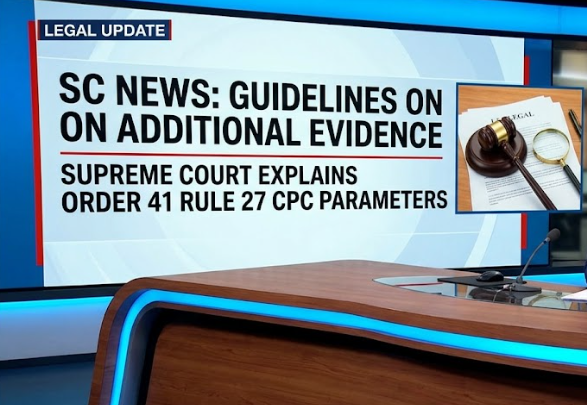
Reaffirming that an application to produce additional evidence in an appeal must be assessed on its merits prior to issuing a final judgment, the Supreme Court of India has established essential guidelines for courts handling applications under Order 41 Rule 27 of the Code of Civil Procedure (CPC)
A division bench comprising Justice SVN Bhatti and Justice NV Anjaria highlighted five mandatory parameters:
Core Parameters for Appellate Courts
- Mandatory Evaluation on Merits: An appellate court has a statutory obligation to address an application for additional evidence on its merits. It cannot disregard or bypass the application while issuing a final judgment.
- Concurrent Hearing: The application must be reviewed simultaneously with the oral arguments of the main appeal. This enables the court to assess whether the proposed documents are required to properly pronounce judgment or serve another substantial cause.
- Explicit, Reasoned Orders: The court must issue a distinct order either accepting or rejecting the application. If the additional evidence is admitted, the court must formally record its reasons for doing so.
- Consistency with Pleadings: Before examining the supplementary evidence, the court must verify that the applicant’s existing pleadings establish a sufficient factual baseline to support introducing the new material.
- Jurisdictional Error: Disposing of an appeal while an application for additional evidence remains pending is a grave jurisdictional flaw that leads to a severe miscarriage of justice.
Case Background & Ruling
The judgment arose from a challenge to an order passed by the Karnataka High Court. In that matter, the High Court had finalized the appeal without considering or ruling on the appellant’s pending application under Order 41 Rule 27 CPC. The appellant had sought to introduce vital supplementary documents to challenge the plaintiffs’ claims, but the High Court rendered its decision without evaluating the necessity of those records.
Overturning the High Court’s ruling, Justice Bhatti emphasized in the judgment that ignoring the pending application constituted a direct failure of procedure. The Supreme Court observed that the High Court was duty-bound to evaluate during the final hearing whether the additional documents were essential for a comprehensive decision. Failing to issue a reasoned order on the application before affirming the trial court’s decree resulted in a procedural breach.
Consequently, the Supreme Court allowed the appeal and restored the Regular First Appeal to the Karnataka High Court for a fresh hearing and determination in accordance with the law.
